Saturday, April 9, 2011

Culinary Trip to Italy, March 2011: Part 1

I was fortunate to have the opportunity to travel to Reggio Emilia, Italy a sister city of Fort Worth, Texas, with the Culinary School of Fort Worth.  Reggio Emilia is located in northern Italy, in the Romanga Region, southeast of Parma.  The Fort Worth Sister City International Program of Fort Worth and the Culinary School of Fort Worth had been planning this trip for a couple years and I first heard about it when I was attending Culinary School from 2008-2009.  Chef Heather Kurima, Director of the Culinary School, visited Reggio Emilia with the Sister City group and told us about her adventures. We also had a couple visits by the culinary students of Reggio Emilia and sampled the local balsamic vinegar and some of their food.
Chef Kurima and Beth Weibel, a Fort Worth Sister City International Program Manager, met with the twelve travelers several times in anticipation of the trip.  Beth told us all about the travel details, brought in TCU students to teach us some Italian, (which was really, really helpful) and was overall a terrific source of information and support.  Chef Kurima developed a detailed and exhaustive itinerary by seeking input from all of us.  We knew exactly where we would be during the entire trip and it sounded fantastic.  In  a nutshell--twelve people (9 chefs and 3 significant others) representing the Culinary School of Fort Worth, traveled to Reggio Emilia, Italy, stopping at JFK in New York, then to Milan.  We spent several hours in Milan, boarded a bus to Reggio Emilia, approximately two and a half hours away.  During our stay at the B & B del Vescovado in Reggio Emilia we visited other cities by train, including Parma, Florence, Bologna, and Verona.

I don’t want to give the impression that all we did on our trip to Italy was eat—but really, it is true to some extent since it was a culinary trip, although we spent time doing many other things besides studying food and eating, such as taking a walking tour of Reggio Emilia, visiting beautiful churches, seeing the Uffizi Museum in Florence, and touring wineries in Verona.

 
Il  SalottoRistorante, Milan

After a long day and night of traveling we were bleary eyed and exhausted. A few of us toured the beautiful Piazza Del Duoma, including going into the beautiful duomo.  We found a little restaurant in the Galleria Vittorio Emanuele. Not wanting a multi-course meal we looked around and saw most people were eating pizza. We had pizza with salami and pizza with ham and mushrooms.
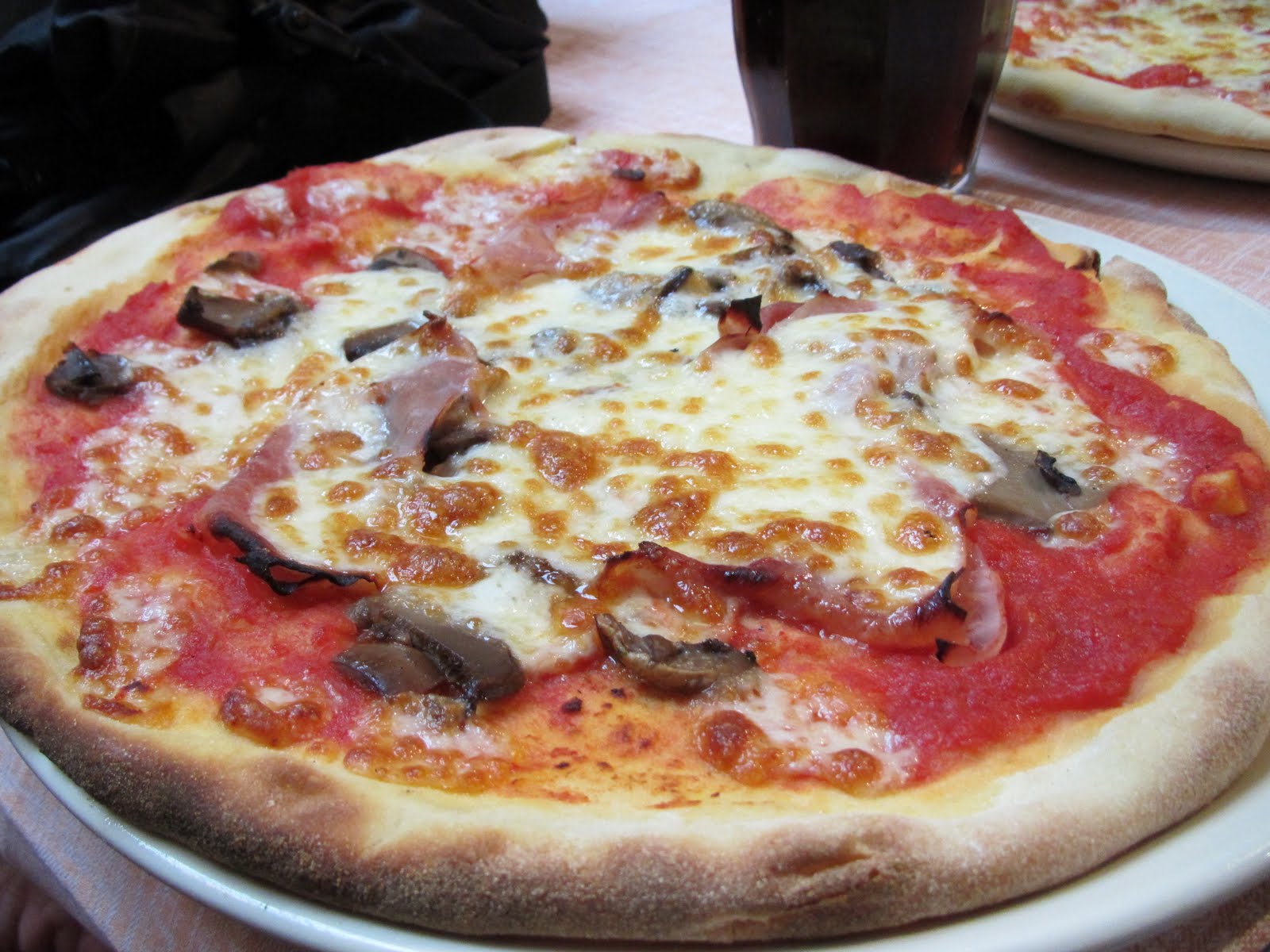

Both were hot, crispy, and delicious. Later we enjoyed a cup of seriously rich hot chocolate as we tried to stay out of the rain for a few minutes. Cioccolata Calda, or hot chocolate in Italy is like drinking a melted chocolate bar—really it has to be eaten with a spoon, it is so thick. With panna (whipped cream) and some biscotti, it's divine.

Reggio Emilia

Reggio Emilio street with flags for Tricolore celebration of 150 years

Bruschetta at La Casseroula

Penne Dorate
We arrived at the B & B del Vescovado in Reggio Emilia after a long bus ride. After getting situated in our rooms we set out to find a recommended restaurant. With a little help we found La Casseruola, one of a few restaurants open on Sunday night.  Steve, Sharon Cofer, a wonderful lady and new friend I met on this trip, opened our menus and saw they were all in Italian.  Fortunately we had a handy restaurant translation guide so we could figure out the menu. It took some effort to figure out all the dishes and we finally ended up ordering a variety of dishes. We had antipasti of bruschetta with salsa rosa, prosciutto, and grana. This was bread with red sauce, prosciutto and cheese—OK but nothing special. We tried the penne dorate with allo speck (ham) and pepeverde (green peppers). The pasta was excellent and the best dish of the night. We ordered braciola di maiale (pork steak) which was tough and dry and spiedino di carne (skewer of beef with onions and peppers). It was also dry and lacked flavor. As I looked around I noticed that just about everyone else in the restaurant, who came in after us even though it was 9:00 PM, was ordering pizza!

After a morning of walking around Reggio Emilia and having an official welcome at City Hall, we stopped in a little restaurant called, Sotto Broletto. This was an unassuming little place but one of my favorites during our stay. I had Tortelli Verdi in Salsa Bianco with Salsiccia (chard tortellini in white sauce with sausage). This is at the top of the tastiest dishes I enjoyed during our stay. It is also one of the local specialties and on every menu (and we would be served it time and time again!) Steve ordered a pizza, Quattro Stagione, with prosciutto, cotto, funghi, salsiccia, and carcioti (prosciutto, salami, mushrooms, sausage, and artichokes). I loved the toppings but the crust was bit soggy.
Sotto Broletto near our B & B, a favorite spot

Friends in Fort Worth group
Tortelli Verdi with Salsa Bianca and Salciccia (I have to make this when I get back!)

Off to Parma where we had some time to wander around by ourselves. It started raining so we slipped into a covered patio and ordered some ciocolattacalda, hoping to have a great cup of hot chocolate like the one we had in Milan. I ordered dark and Steve ordered milk. We got very thick cups of chocolate, like the melted chocolate bar but even thicker than Milan’s. We ate it with a spoon.

I have since looked up a recipe for Italian hot chocolate, Ciocolatta Calda and here it is:
1 cup milk
3/4 cup heavy cream
3 T unsweetened cocoa powder
2-3 T sugar
2 tsp cornstarch

Measure the milk, cream, and cocoa powder into a saucepan and set it over medium heat.  Begin whisking to incorporate the ingredients, and reduce heat to medium-low to prevent it from boiling.  When milk is warm, gently whisk in 2 T of the sugar.  Continue cooking over low flame until dissolved and steaming hot. 
Measure cornstarch into a small bowl.  Spoon a little of the hot chocolate mixture into the bowl and stir it into the cornstarch.  Pour this mixture into the hot chocolate and continue to whisk over low heat for another couple minutes, until thick and smooth, but still drinkable.  Serve with a cookie for dipping, eat it with a spoon, but take the time to relax and savor it, a little at a time.

We walked around Reggio Emilia Monday evening and found a restaurant called A Mangiere, a very pretty restaurant. Had we known what was in store for us later in the week we would not have ordered what we did (and you will see why when you read all the posts on Italy) We ordered gnoccofritto (fried pasta) and prosciutto along with some other local hams.

Gnocco Fritto (fried pasta) served with local meats is a local antipasti

Local meats, 2nd time

Husband Steve enjoying his lambrusco

Tortelli Verdi (2nd time)
We also ordered a bottle of Salamino De S. Croce Lambrusco. Lambrusco is a sparkling wine and we would have many more glasses of it during our stay as it’s also the local popular wine. Steve ordered Tortelli Verdi and I had the Risotto with Raddichio, cheese, nuts and bacon. We did not order a meat course after our experience the first night, and also because we had a pretty big eating day already!

Cheese Factory
Lateria Sociale Villa Sesso


The visit to the Parmigiano Reggiano cheese factory was fascinating.  I had no idea what went into making this cheese but I developed an appreciation of the process after the morning we spent viewing all the hands-on labor that goes into making one wheel of perfect cheese.  There is only one authentic Parmigiano Reggiano cheese and it comes only from this area of Italy.  The process is high regulated from the type of milk (only raw milk from certain cows who have a grass fed diet on local farms in the area), to the long aging process.  The cheese is sold only after it is aged for a minimum of two years and some at 30 months.  Younger cheese that doesn't earn the seal of Parmigiano Reggiano is sold as parmesan.  We sampled their cheese, both the two year and the 30 month and the taste was nutty, salty, smooth, and hard to describe.
We bought 2 kilos of both types to bring back and we still have a kilo of the 30 month cheese vacuum packed in our refrigerator.  We will bring it out when we have our Italian feast for friends and family.  So all that "parmesan" cheese you are used to eating is bland compared to the real thing and if you see that a pound of Parmigiano Reggiano cheese is nearly $20.00 a pound in Central Market there is a good reason for it.

The Motti School

Steve ready to cook!
 We discovered a unique educational method in Italy.  Students at the Motti School were part of a high school program.  In fact the school itself was a regular high school with a section for the culinary program.  Students who are interested in the culinary field, to include cooking and serving, go to the culinary program instead of a regular school program.  When they graduate from high school they are certified to work as culinarians.  We may have some similar programs in the states but I'm not too familiar with them.
We were introduced the the staff and students, some of whom had been to Fort Worth and visited the Culinary School of Fort Worth previously.  We changed from our street clothes into chef uniforms.
Even the non-chef members of our group were required to wear the full chef uniform from the Culinary School of Fort Worth.  My husband, Steve, who does not cook much at all, was a good sport and wore the uniform without complaint.  We were assigned to various students to prepare the meal we would eat later.
I was assigned to make pork tenderloin stuffed with ham and parmesan cheese with a lambrusco sauce.

Samuel pouring wine on the pork
 Steve observed this time (but later in the trip he won't be so lucky!)  My student, Samuel Carpi, was really sweet.  He asked me to help brown the tenderloins which had been tied with string.  The strange thing was there were no utensils to turn the hot pork.  He was merely using his fingers to turn the meat and had one spatula which was not very useful on round objects.  I did my best to brown the meat and turn it "by hand" but it was crazy.  We poured white Marsala and lambrusco wine all over the pork along with some fresh rosemary, sage, and garlic, and placed it in the oven.  The sauce was made from drippings in the pan, more wine and cream. Although it was a weird pink color it was delicious.  The stuffed pork with wine sauce was one of the best things I had during the trip and I already made a version of it at home.  I made an unstuffed pork tenderloin with rosemary, sage, and garlic with a red wine sauce.  The sauce stayed dark red because I used butter instead of cream.  It was wonderful.

All the members of our group were busy in the large kitchen cooking the various components of our lunch.
I wondered if high school students in America would have access to all these bottles of wine for cooking?
Finally it was time to eat!


Time to eat!

Menu
Antipasti Course
Rustici Di Sfoglia (rustic pastry) stuffed with frankfurters and anchovies
Pizette Di Sfoglia (like a mini pizza with cheese)
Erbazzone (the local savory pastry with spinach, ricotta, and onions)
Brocolli Flan with Gorgonzola


Pork with Lambrusco Sauce

Primi Course
Lasagne Alla Bolognese

Secondi Course
Pork Fillet Stuffed with Raw Ham and Parmesan Cheese with Lambrusco Sauce

Contorni (side dish)
Roasted Potatoes with Rosemany, Sage, and Garlic

Dolci (dessert)
Panna Cotta with Strawberry Sauce
Tiramisu

Did I say that this was just lunch?  We had lots of wine, course after course, and the school officials and staff were so warm and friendly.  The students were so sincere and hard working as they waited on our tables and poured the wine.  What a lovely place and great experience.  The food was outstanding.  My panna cotta never turned out so light and smooth.  My favorite dish was the pork and roasted potatoes.  Even the humble potatoes were special--perfectly cooked and creamy.  I am looking forward to seeing the Motti students on their next visit to Fort Worth so I can thank them again!

The Motti students


After our busy day we still had one more event, a visit to the Reggio Emilia Chamber of Commerce.
Their brand new meeting room was set up with a u shaped table where we sat and were treated to a variety of local products delightfully described by our host, Romeo Catallani.  Romeo was charming, funny, and entertaining as he described the traditional balsamic vinegar, Parmigiano Reggiano cheese, and the lambrusco wine.  He also emphasized that Lambrusco wine is good with pork and pork is plentiful in the area.  The whey from cheese production is fed to the pigs which makes for really good pork in this region. 


Romeo is on Facebook!

Traditional Balsamic, the good stuff on Parmigiano Reggianno--oh my


Look familiar--the meats, grissini, cheese
A
Lambrusco!


Later in the evening we headed out to Sotto Broletto for a light (ha ha) dinner.  I had yummy spaghetti carbonara  and Steve tried the Tagliatella with ham and peas.  Both were hot, perfectly cooked, and delicious.

Spaghetti Carbonara


The next morning we left bright and early for Florence by train.  First on the agenda was a City Gastronomic Walking Tour.  It started at the Apicus International School of Hospitality.  The tour guide took us to the Mercato centrale, open since 1874.  She pointed out Nerbone, a popular place where a boiled beef sandwich is served.  We didn't have time to try anythiing during the tour but Steve and I went back later in the week and actually tried a beef sandwich at Nerbone.  We didn't remember that we were supposed to order it "bagnato" (dipped in juices) so our sandwich was very rare, very tough beef and barely edible.

in the Mercato centrale

Next was the Coltelleria Galli, a knife store, then the Procacci, a Florence style delicatessen known for a glass of prosecco and a finger sandwich with truffle cream.  We got to try the truffle sandwich and it did have a truffly taste, but truthfully, I don't like the taste of truffles.  On to the Uscio e Bottega, a tiny place where excellent wines are served with traditional Italian cold cuts, breads and cheeses (here it comes again!)

After sampling a variety of excellent wines, some fantastic eggplant, pictured above, we finished our walking tour at the Ribiglio, a  cafe and pastry shop.  I purchased some chocolates which we enjoyed the rest of the trip and brought home the rest.  During the tour the guide told us about the local foods.  I learned that people in Florence eat lighter foods than the Reggio Emilia area.  They tend to eat a lot of fresh vegetables, including minestra soup.  Minestra is turned into ribolitta, a vegetable soup with pieces of stale bread.  The bread is also used in panzanella, a mixture of soaked bread, cucumbers, basil, tomatoes, salt, and olive oil.  I tried the ribolitta later in the evening and it was rich and flavorful.  I have since made it at home and loved it.
Our tour guide


a steet in Florence

great shopping near the Mercato centrale


This was a great place to shop for food and gifts to take back.


View of Pontececchio from a  window in the Uffizi Museum


B Gallo Restaurant next to the Duomo--what an amazing place to have a bowl of ribolitta and a pizza.


a delicious bowl of ribolitta

We all liked this wine rack.

to be continued

Sunday, March 6, 2011

Private Cooking Class with Linda Johnson

 Menu
Pesto Pasta Salad with Salmon
Tomato Basil Soup
Compost Cookies
We had a great time yesterday both cooking and visiting.  I have to watch Linda, though, or she will get distracted talking and put 2 cups + 2 tablespoons of flour in the recipe instead of 2 cups - 2 tablespoons of flour!  She is a lot of fun and always has the best attitude about trying new things.  She had never recalled having pesto before and had no idea what went into it.  Classic pesto has basil, pine nuts, garlic, Parmesan cheese, olive oil, and salt and pepper, however there are many variations made with cilantro, spinach, parsley, hot chili peppers, and various herbs.  I liked the idea of a spinach and basil pesto so that's what we made.  We added some toasted pine nuts, garlic, and Parm in the pesto and Linda's little food processor worked just fine.  The end result was a flavorful, fresh and beautiful green puree.  We added the pesto to some cooked and cooled bowtie pasta along with diced sundried tomatoes, grated Parmesan cheese, and thinly sliced scallions.  A little Caesar dressing was added to give it more moisture.  We served the pasta with a beautifully seared piece of salmon.  I tasted the pasta and decided I would make the exact same dish for my family the very next day!  (I had never made this recipe before so I was happy it turned out so well, but had no idea I would fall in love with it.) Linda, it turns out, loves pesto and is excited to have something she can make with her herb garden this summer.  I told her she could use pesto in her frittatas, on her seared chicken breasts, as a pizza topping, mixed with goat cheese for a spread, on grilled cheese sandwiches, and many more ways, and that it freezes very well.
Pesto Pasta Salad with Salmon

Linda tasted the salmon and said she really liked it.  It was perfectly cooked, crusty on the outside, moist on the inside and seasoned well.  She has never prepared fresh fish and she and her husband don't usually eat seafood, unless you count fried catfish.  This is another example of how willing she is to try new things and she was pleasantly surprised to find that the salmon tasted good to her.  Her husband, Baker, also liked it.
When she paired a piece of salmon with a bite of the pesto pasta salad the combination of flavors was perfect together.

Recipe for Pesto Pasta Salad


Pesto
4 cups washed spinach leaves
3 garlic cloves
3 T pine nuts
handful fresh basil leaves
1/4 cup (or more if needed) olive oil
1/3 cup grated Parmesan cheese
1/2 tsp salt, fresh ground pepper
Place all ingredients in a food processor and pulse until smooth.

Pasta Salad
8 ounces bowtie pasta, cooked and cooled
4 T pesto
1/2 cup sundried tomatoes (in oil) diced
1 T Parmesan cheese, grated
2 T Caesar dressing
2 thinly sliced scallions
Combine all ingredients.  Garnish with more sliced scallions.

Salmon
1 lb salmon fillets with skin
1 T olive oil
Salt and pepper
Heat a skillet over moderate heat for 3-4 minutes.  In the meantime put the salmon fillets on a plate and coat with olive oil.  Season with salt and pepper. Add fillets to pan, flesh side down. Cook over high heat until browned, about 3 minutes.  Turn over and cook until skin is deeply browned, about 5 minutes longer.  Transfer to plate and serve with pasta.

Tomato Basil Soup
We made tomato basil soup similar to the famous Le Madeleine soup.  Linda loved the flavors of the fresh tomatoes and basil.  She is a tomato lover and plans to have lots of tomatoes in her garden this summer.
We used both canned tomatoes and fresh tomatoes for the soup.  I showed Linda how to "concasse" the tomatoes by dropping them in boiling water to loosen the skins, then removing the seeds before chopping them for the soup.  We used low sodium chicken stock, some unsalted butter, and a little cream.

Tomato Basil Soup
 The soup was heavenly.

Tomato Basil Soup
1 28 ounce can chopped tomatoes plus 1 lb fresh tomatoes, peeled, seeded and diced
3 cups low sodium chicken stock
1/2 cup fresh basil leaves (plus additional for garnish)
1 cup whipping cream
1/4 cup unsalted butter
salt and pepper to taste
Combine tomatoes and stock in saucepan.  Simmer for 30 minutes over medium low heat.  Using immersion blender, puree carefully.  Add basil and puree again.  Add cream and butter.  Stir over low heat until heated through. Add salt and pepper.  Garnish with fresh basil and serve.

I have another version of this soup that I plan to make this evening.  The 5 pounds of tomatoes are all fresh, roasted with  6 garlic cloves and 1/4 cup olive oil in the oven at 450 degrees for 40 minutes.
Saute a cup of chopped onions in 2 T oil, stir in 2 cups water, 2 t sugar, 1/2 t salt, 1/4 tsp red pepper flakes and simmer for 10 minutes.  Puree with blender, add 1/2 cup heavy cream at the end.

Compost Cookies

I mentioned the compost cookies to Linda last time we had a lesson and she wanted to make them for her husband, for whom she routinely buys fancy gourmet (expensive) cookies.  I know that "compost" is a strange name for a cookie but it refers to scraps you might have around your kitchen such as various bits of candy, chips, cereal, cookies, nuts, etc. in any combination.  A version of compost cookies is a popular item at Momofuku, a trendy restaurant in New York City, and their compost cookies cost $20.00 a dozen.  Linda, did you read that?  Your 4 dozen cookies would cost $80.00!!  When Steve and I were in Ouray, Colorado last year we had a cookie called, "scrap cookie" in Mouse's chocolate shop.  They took various candy "scraps" such as truffles, caramels, toffee, and nuts and made unique cookies, different every time.  There were awesome.
My recipe for compost cookies is not the same as Momofuku's.  After reading various comments made on sites where people had used the "real" Momofuku recipe from Christina Tosi (who demonstrated it on Good Morning America a while back), I kept seeing disappointing end results.  Chocolate chip cookies tend to flatten out when baked but I corrected that problem so my cookies turned out chewy, crunchy, and shaped just right.  Both Linda and her husband were happy with the results and I have a feeling she will make more of these cookies some day.  I am not posting that recipe (have to keep some things secret) but I will say we added Callebaut chocolate chips, Lindt white coconut chocolate, Kettle sea salt potato chips, pretzels, and pecans a a sprinkle of sea salt.  Yum, yum, yum.

Compost Cookies

Linda is anxious for me to leave so she can eat!


Sunday, February 27, 2011

Burgundy Pasture Farms Bone-In Ribeye with mushroom sauce, smashed potatoes, and glazed carrots


We bought some grass-fed beef from Burgundy Pastures Farm in Grandview and I finally had a chance to use one of the steaks.  At $25.00 a steak, this bone-in rib-eye was a bit pricey so I wanted to make something tasty.  I've had it with expensive restaurant steaks that have no flavor, no texture, and no juiciness but cost a small fortune.  I was pleased with the end result,  a very nicely seasoned, juicy, tender steak.  You can't see the smashed red potatoes underneath but they were carmelized, seasoned with a little butter, salt and pepper.  The baby carrots were tender and sweet with a nice bite.
Here's what I did:
Rub the steak with 1 tsp kosher salt, a tsp brown sugar, 1/2 tsp garlic powder, 1/2 tsp cayenne pepper.
Heat a cast iron skillet until very hot.  Add 1 T olive oil and sear steak for 4 minutes, each side. At this point it will probably be medium rare, depending on the thickness. To cook a little more, put steak, pan and all, in 350 degree oven and cook until desired doneness, 6 minutes or more depending on thickness of steak.  Allow steak to rest tented by foil for 5 minutes before serving.

After removing steak from pan and 2 T chopped shallots, 3-4 sliced cremini mushrooms, salt, 2 T red wine, and 1 cup beef stock.  Simmer until reduced by almost half.  Add 2 tsp butter.

For the carrots, peel and trim a pound of baby carrots, leaving a bit of the green top on.  Place in saute pan and cover with low sodium chicken stock, add 1 T brown sugar, dash of cinnamon, dash of cayenne, squeeze of lemon and simmer until sauce is reduced to a thick glaze.  Carrots will be done by then.

For the potatoes, cut red potatoes into 2 inch pieces and simmer until fork tender.  Drain.  Heat saute pan, add olive oil and saute potatoes until brown.  Season with salt and pepper.  Smash down with a large spoon.

To plate, cut bone off rib-eye and set the bone aside.  Slice steak into several pieces.  Place mound of potatoes on plate, place pieces of steak and bone on top of potatoes.  Add a few carrots on the side.  Spoon sauce over steak.
Enjoy with a glass of Blackbart Syrah from Stagecoach Vineyards, Napa Valley.

Twitter Delicious Facebook Digg Stumbleupon Favorites More